Last updated: 24 September 2026
One of the biggest lifestyle changes when you move to the Netherlands from South Africa, or from most other countries, is how little you need a car. Trains run every few minutes between the big cities, buses and trams reach almost everywhere, and the bike is the fastest way around town. Once you understand how paying works, getting around is easy.
This guide explains public transport in the Netherlands for newcomers: how to pay with OVpay or an OV-chipkaart, how trains work, off-peak discounts, bikes, apps and the changes coming up.
Short answer: The easiest way to pay is OVpay: just tap in and out with your contactless bank card, credit card or phone on trains, trams, buses and metros. For regular travel, a personal OV-chipkaart with an NS discount subscription can save you a lot, especially off-peak. The OV-chipkaart is being phased out and replaced by a new OV-pas by the end of 2027. Use the NS app for trains and 9292 for door to door journeys.
Jump to: How to pay | Trains | Buses, trams and metros | Saving money | Bikes | Apps | Changes coming up | FAQ
How to pay for public transport
OVpay: tap with your bank card or phone
Since 2023, you can check in and out on all trains, trams, buses and metros across the Netherlands with a contactless debit card, credit card, phone or smartwatch. This system is called OVpay. You pay the normal full fare, and it is charged to your card afterwards. It is perfect for visitors and for your first weeks here, before you have a Dutch bank account.
- Hold your card or phone against the card reader when you get on, and again when you get off.
- Always use the same card or phone to check out. If you check in with your phone and out with your card, the system sees two separate journeys.
- Each traveller needs their own card or device.
- If you forget to check out, you pay a maximum fare. For trains, the maximum rose to €33.30 in 2026.
The OV-chipkaart
The OV-chipkaart is the Dutch public transport smart card. A personal OV-chipkaart, with your name and photo, is what you need if you want an NS discount subscription or a subscription from your employer. You load credit onto it or link it to automatic top up, and you check in and out in the same way. Trains require a minimum balance on the card when you check in.
Taking the train
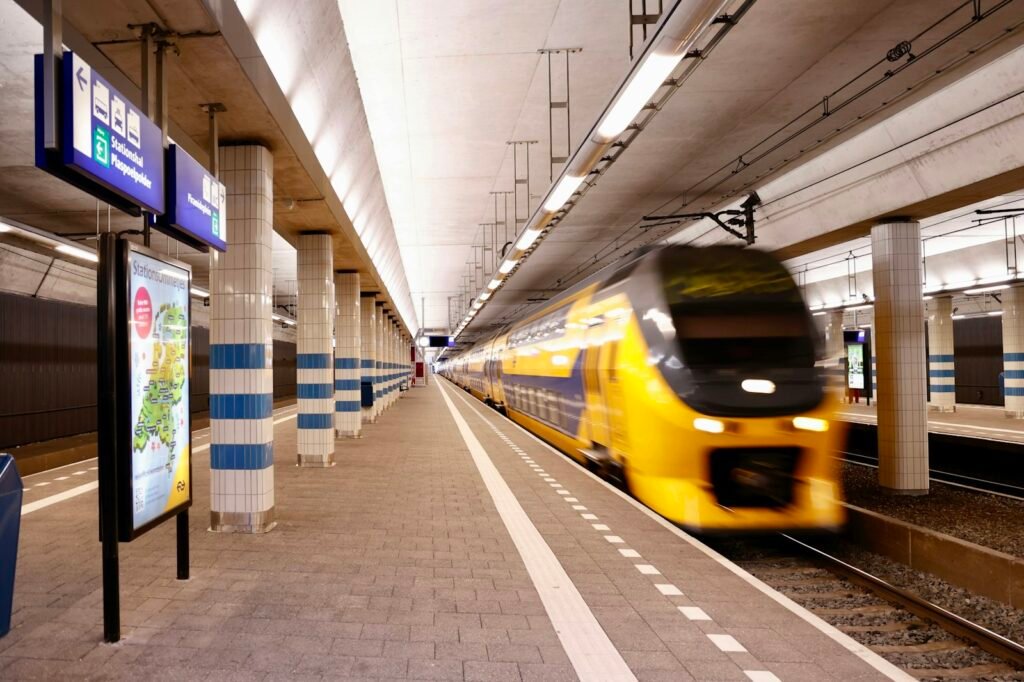
NS runs most trains in the Netherlands, with some regional lines run by other companies. There are two main types: Intercity trains stop only at bigger stations, and Sprinter trains stop everywhere. Trains between the big cities in the Randstad run very frequently, often every 10 to 15 minutes, and a night train network connects cities like Amsterdam, Utrecht, Rotterdam, The Hague and Schiphol.
| Route | Rough travel time |
|---|---|
| Amsterdam Centraal to Schiphol | About 15 minutes |
| Amsterdam Centraal to Haarlem | About 15 minutes |
| Amsterdam Centraal to Zandvoort | About 30 minutes |
| Amsterdam to Utrecht | About 25 minutes |
| Amsterdam to The Hague | About 50 minutes |
| Amsterdam to Rotterdam | About 40 minutes by Intercity Direct |
| Amsterdam to Eindhoven | About 1 hour 20 minutes |
- First or second class: first class is marked with a big 1 on the carriage and is quieter at rush hour. You must check in for first class.
- Quiet carriages: look for the “stilte” sign. No phone calls or loud music.
- Intercity Direct: the fast train between Amsterdam, Schiphol, Rotterdam and Breda requires a small supplement on some sections.
- International trains: you can reach Brussels, Paris, London, Cologne and Berlin directly from the Netherlands.
- Bikes on trains: you need a bike day ticket and you cannot take a normal bike on board during rush hour on weekdays. Folding bikes are fine.
Trains fill up at rush hour, roughly 06:30 to 09:00 and 16:00 to 18:30 on weekdays, and on sunny weekends to the beach. See our guide to Zandvoort, the beach near Amsterdam if you want to join them.
Buses, trams and metros
Local transport is run by different companies in each region: GVB in Amsterdam, RET in Rotterdam, HTM in The Hague and others elsewhere. The good news is you pay the same way everywhere, with OVpay or your OV-chipkaart. Some operators also sell day tickets and local passes, which can be good value if you travel a lot in one city. Amsterdam trams and buses do not accept cash.
Saving money on public transport
- Off-peak travel: NS discount subscriptions give big discounts outside rush hour. Off-peak on weekdays is before 06:30, between 09:00 and 16:00, and after 18:30, and all day at weekends and on public holidays.
- NS subscriptions: NS offers discount and unlimited travel subscriptions, loaded on a personal OV-chipkaart. The line up changed in 2026, so check the NS website for the current options.
- Travelling with others: some subscriptions give discounts for people travelling with you.
- Children: children under 4 travel free, and with the Kids Vrij subscription, children aged 4 to 11 can travel free on NS trains when they travel with an adult (up to three children per adult). A Railrunner ticket for kids is €2.50.
- Ask your employer: many employers pay for your commute, either with a travel allowance or an NS Business Card.
- Fares go up every January. In 2026, NS fares rose by an average of 6.52%.
Bikes: the real Dutch transport
For short distances, the bike is king. Most Dutch people cycle to the station, to work, to school and to the shops. It is cheaper, often faster than public transport, and the infrastructure is excellent.
- OV-fiets: NS rents bikes at most stations for €4.80 per 24 hours in 2026. You need an NS account and a personal OV-chipkaart. Perfect for the last part of your journey.
- Buy a second hand bike: a good used city bike and two strong locks are the best investment you can make in your first week. Bike theft is common in big cities.
- Lights are compulsory when it is dark, and you will get a fine without them.
- No phone in your hand: holding a phone while cycling is illegal and gets you a hefty fine.
- E-bikes and fatbikes: e-bikes are very popular, including for commuting longer distances. There is currently no helmet requirement, but the government is working on rules, including a proposed helmet obligation for riders under 18.
- Follow the rules: stay on the bike path, signal with your arm, and watch out for trams and tram rails.
Useful apps
- NS app: train times, platform changes, disruptions and tickets.
- 9292: door to door planning with all public transport in the country.
- Google Maps: works well for public transport and cycling routes.
- Local transport apps: GVB, RET and HTM have their own apps with day tickets.
Changes coming up
The Dutch public transport sector is replacing the OV-chipkaart with a new system. The current OV-chipkaart is due to be phased out by the end of 2027 and replaced by the OV-pas, which stores information online instead of on the card and works better with your phone. OVpay with your bank card keeps working. If you have a personal OV-chipkaart with a subscription, you will be told how and when to switch.
Frequently asked questions
Can I pay for trains in the Netherlands with my bank card?
Yes. With OVpay you can check in and out with a contactless debit card, credit card, phone or smartwatch on all trains, trams, buses and metros.
Do I need an OV-chipkaart?
Not for occasional trips, because OVpay works everywhere. A personal OV-chipkaart is useful if you want an NS discount subscription or travel a lot.
What happens if I forget to check out?
You pay a maximum fare. On NS trains this was €33.30 in 2026. You can sometimes request a refund through the NS or your transport company.
How do I get from Schiphol to Amsterdam?
Take the train from Schiphol to Amsterdam Centraal. It takes about 15 minutes and you can pay with OVpay.
Is the OV-chipkaart being discontinued?
Yes. The current OV-chipkaart is being phased out by the end of 2027 and replaced by the OV-pas.
New here? See our complete moving guide and our comparison of the best cities to live in, where good train connections make a big difference.
Sources: NS: fares in 2026, OVpay, Wikipedia: OVpay, ANWB: fatbike and e-bike rules.